
I love Gees Bend quilts. They have a freedom (born out of both necessity and isolation) that traditional quilts don’t come close to having.
You can read about them here:
So a few years ago when I was given a big coffee table book on the Gees Bend community of quilters in Alabama I felt so lucky. Flipping through the pages once I saw a quilt, made by Loretta Pettway, that literally made me gasp. The color combination was so unusual and bold: orange, mint green, light purple, red, black and white. I knew I wanted to recreate it and right away dug out my stash of Solids to see if I had the same colors. I didn’t. I needed the orange, light purple and mint green. Yea! Another excuse to go shopping.
Loretta Pettway used synthetic knits and cotton sacking in hers.
Here’s a photo of it from the book. 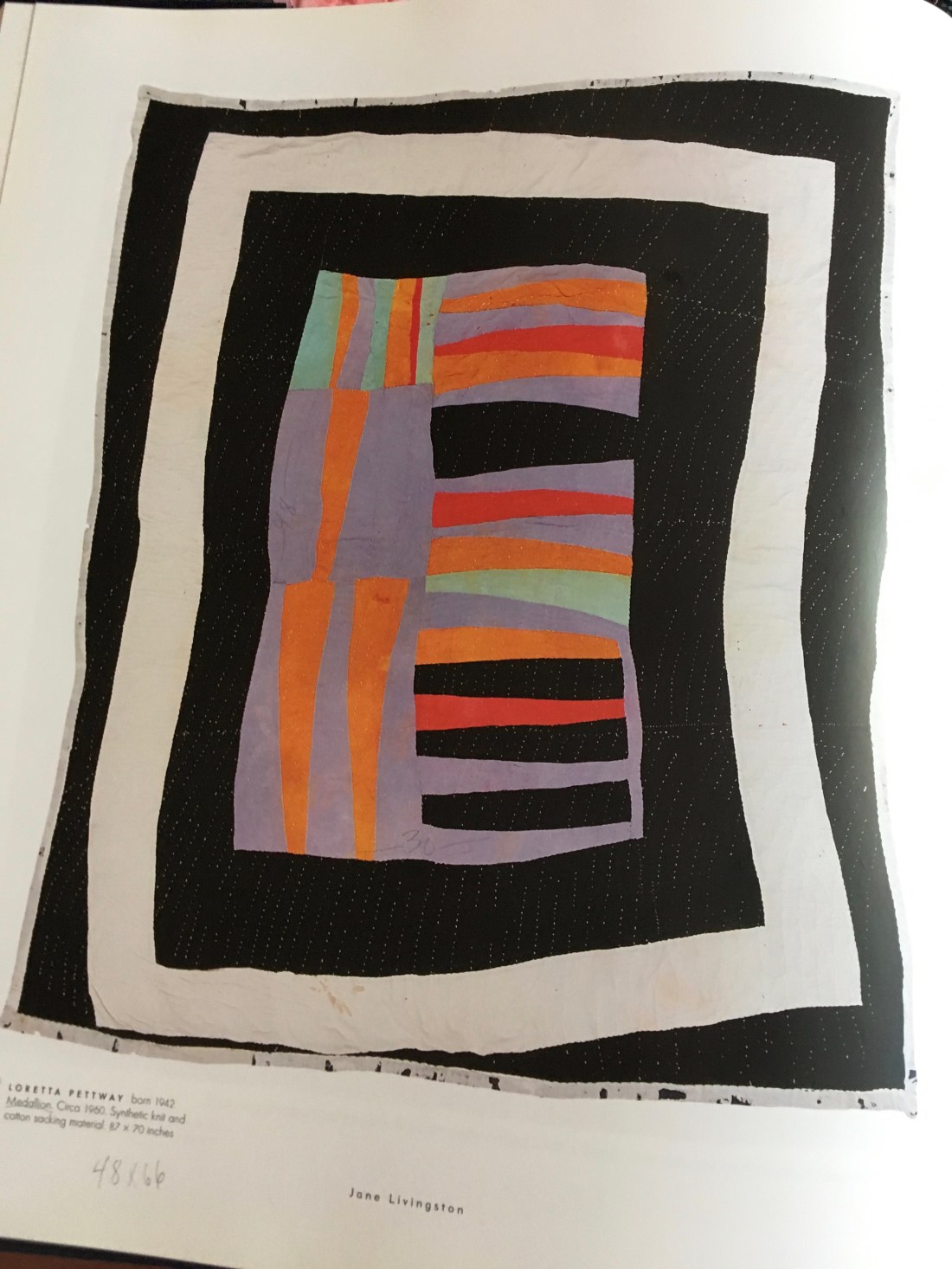
I used cotton solids and the “wrong” (reverse) side of one orange print because I couldn’t find a solid I liked in the right shade. But not wanting to just be a copycat, or a thief, I added a pieced element in the last border, then purposely cut the whole thing slightly “wonky”.
After I got the quilt top done I put it away, not knowing how to quilt it. I moved on, as is my wont … (Not necessarily a habit I am proud of.)
A few weeks ago, looking for something else in the closet, I saw it hanging so forlornly, and decided it was time to get the quilt quilted; that it had been hiding away forgotten for too long. It was time to bring it to life. To let it live in the light of day.
I felt it only needed something simple, because the quilt itself makes such a wonderful bold statement it would be a shame to have quilting that distracted from that statement.
Many contemporary quilters are using what they call “matchstick” quilting to quilt their quilts: straight parallel lines very close to each other and easy to do on one’s sewing machine. I’ve always liked that look of disciplined lines so I decided to try it on this one.
Well, I found out it is impossible for humans to make straight lines, thanks to our beating hearts and our breathing lungs. Which of course is why rulers were invented. Or painter’s tape.
I laid down a long strip of blue painter’s tape for the first sewing line, then used the edge of my quilting foot as my guide to follow that one. However, after a few lines, I realized even so that my lines were not perfectly straight. More than once I thought I should stop and rip them out and start over again, to try to aim for perfection, or with a completely different design. But I didn’t want to rip a thousand tiny stitches out either. So I just kept going. And going and going. Until I realized, and then remembered, that I’d purposely made my borders “wonky”, i.e. off-kilter, in keeping with the center pattern and the Gees Bend aesthetic. Of course. Which meant it was going to be impossible to have my quilted lines run parallel at the borders and out to the very edges.
“So be it!” I kept saying to myself over and over. Kevin even heard my moans and sighs. But by now I was committed. There was nothing for it but to get to the end and make my final line of stitching. And my Bernina walking-foot did a fantastic job. Underneath I used whatever color threads I had already had wound on bobbins, and they all matched the variegated thread I used on top. I emptied a lot of bobbins and that was surprisingly satisfying. Except when I ran out of bobbin thread in the middle of a line …!
Quilters learn (maybe other artists learn this, as well) that the eye is very forgiving. That the brain wants to see a “whole”. And thank goodness! Because when I was finally done and I had taken an objective look at the finished quilt, I found that for the most part the lines worked. (I just counted them. 94 in all.)
The quilt measures 49″ X 65″ because I envisioned it on the table in our breakfast nook. It does look nice with both the Pfaltzgraff black dishes and the white china.
Thank you, Loretta Pettway, for the gift of your quilt, Medallion, to the world.


 Sings the Raven
I so enjoyed reading about the creative process you go through! Keep up the great work.
LikeLike
Thank you!
LikeLike