Birch Trees in Winter

I saw a quilt called Birch Trees on a blog I follow occasionally. The quilter, Amanda Jean Nyberg, has wonderful ideas for using the smallest scraps. And since I am one of those that is reluctant to throw fabric into the waste basket, and since I loved the quilt she made from her tiny scraps, I decided to make my own version of “Birch Trees.” Here’s a link to hers: bright birch trees

I wanted to use various backgrounds that reminded me of a winter sky, so I chose different light batiks in blues and grays.  The trees were great fun to make and it was so satisfying to me to find a use for the tiniest pieces of bright scraps of prints and batiks in my stash.

For the fun of it, I made one block colorless: a black and white rendition.

For the back I used a dusty blue batik that looks not so much like “starry night”, but more like “starry day”.

I chose to quilt the blocks very minimally, in straight and narrow lines that imitate the trees as well as intersect them, as though each block includes a “ghost” or a mere “idea” of a tree populating the winter scene.


The method I used for construction was QAYG, (Quilt As You Go) — a method of quilt making that, theoretically, allows the quilt to be completed fairly quickly and with minimal stress.  Theoretically, being the operative word!

The quilt measures 52″ X 55″, a nice size for a modern minimalist baby quilt. But it looks good on a small table, too. Or hanging on a wall.

Price: $75 + S/H.

Sold.


Singing the blues and greens

I bought a Fat Quarter bundle of Kona solids (fabrics with no surface design, just solid color) at the quilt show in February and decided to put them together with a quick, easy pattern. I chose another one from blueundergroundstudios.com, this one called In and Out.

While I worked on it I kept resisting the powerful urge to add a bit of hot pink, orange or red to the palette, which to me seemed too tame; too “yawn.” But I disciplined myself and managed to finish the quilt, sticking to the original colors.

As I put it together I kept casting around for a quilting design to do on it and finally decided this was the perfect quilt to attempt an idea that my artist cousin had suggested years ago to me, but which I laughed off at the time as a little too out-of-the-box, or radical.  Her idea being — to write one of my stories on a quilt. At the time I wasn’t able to bridge the two worlds of Quilting (working with fabric) and Writing (working with words.) The two worlds of Concrete vs Abstract.

While I didn’t write a story on this one, (maybe next time!) I did start out writing synonyms for “blue” and “green”, then did some free association with what those colors suggested to me in nature and ended up with a sort of poem at the end.

I’ve always loved the look of notebook pages filled with handwriting. To me it means someone is doing both a lot of thinking as well as being faithful (even obsessively!) to their muse. So this quilt was great fun to quilt (instead of the usual angst and stress I experience) because the writer in me finally got the marry the quilter in me! I wrote on the whole quilt top to bottom, side to side, almost without effort.

In fact, it was joyous.

My only dilemma — a small one! — was whether to go back over it to dot the i’s and cross the t’s. I decided to do one and not the other. It took me about 45 minutes to run the quilt through my sewing machine for about an inch and a half of straight stitching to cross the 15 or 20 t’s and about an hour after that to tie off those threads and bury the knots.

And I ended up being grateful for the quiet color palette. And also amazed at how legible my penmanship is when done with a big heavy quilting machine as opposed to the penmanship in my pen-and-ink journals. Those are almost indecipherable.

So I’ll definitely use this method of quilting again. I felt so free. Free to be me! Who knew that my two creative worlds could be bridged … and so easily.


p.s. Kevin loves it too and said “You should keep this one!”  So it’s going to hang on our red wall for awhile. Until he and I are both ready to part with it.

Sail away!

The friend who gave me a stack of pink and green batiks also gave me some leftover batik strips in shades of blue and white.  I immediately chose a checkerboard pattern for them, but half way through decided to add both yellow and orange batiks from my stash to break up what I felt was the monotony of the blue and white.

When I went shopping for a backing fabric I found a cute sailboat print in blue & yellow. It is also a Reproduction, but from the 1930’s, not the 1800’s.  US fabric companies in the 1930’s started designing cute prints in bright, happy colors to help cheer up the population living through the Great Depression: Pink elephants and orange camels. Polka-dot dogs and dancing cats. Little boys and girls at play. Daisies, toys, teacups, kitchen & sewing supplies, objects that suggested travel and adventure — basically every item and theme that might bring people pleasure. Help them dream a little for a better day to come.

1930’s Repros are rarely, if ever, my usual choice for quilt making, but every once in awhile I find one that works well with what I’m doing and it’s fun to make that kind of discovery.

The quilting on this quilt is, as I’ve said, one of my favorite designs: Water. If I could quilt every quilt this way I’d be happy!  (I must have been a fish in a previous life. Or perhaps, according to Chinese philosophy, water is my element.)

I finished the quilt with a yellow batik binding, sewn on my Juki. What a fast and efficient way to do a binding!

The quilt measures 50″ X 70″:  the perfect size for a picnic … a child’s bed … or an afternoon nap. Anyone who has been to my home knows I love to put quilts on the table, too.

UPDATE: I gifted this quilt to the friend who originally gave me the blue and white batik strips. And she loved the blue and yellow sailboats on the back! Hopefully it will find a lovely spot in her new home by the water.


A little Log Cabin quilt

I worked for a few years in a quilt shop whose owner stocks the shelves generously with fabrics known in the quilting world as “1800 Reproductions.”  These are fabrics that companies are putting out based on historical research into colors, themes and designs used by quilters in the 1800’s, including during the American Civil War.  I didn’t care that much for them at first, thinking them too “old-fashioned” and preferring to make my selections from the batik section of the shop.  But so many of my colleagues, not to mention the shop owner, were making truly beautiful and sometimes breathtaking quilts with these 1800 Reproductions, or “Repros” for short.

So I started buying a few pieces — especially the saturated blues, greens, reds, golds and deep pinks — and I soon found the fabrics had their own charm, richness; even a depth to them that was compelling. So I bought more. And then more.

I did quite a bit of patchwork with them, some of which I finished up, but other pieces I put away because I was soon moving on to something else.

Recently, while looking through my stash of “Repros” for some fabrics to make a large Broken Dishes quilt (written about here in an earlier post) I pulled this finished Log Cabin top out of one of my bins and was surprised at how much work I had put into it!  And also wondered why I had sort buried it away.  The finished strips, i.e.”logs,  are only 3/4″ wide, making each separate block finish at 5 1/5″. I’d used dozens and dozens of prints and hues, many of which I’d forgotten I ever had in my collection! So I decided it needed finishing up and of course, it demanded to be hand-quilted.

Now that is is finished I love it enough that I’m thinking of making another one, only much larger. And I still have of plenty of “Repros” in my stash to get me started. I even have small plastic bags of already cut strips (because I can’t bear to throw anything out!) so I could start tonight if I wanted. And then, when I’ve used up my stash, I can go back to Nancy’s shop and purchase so more of these gorgeous fabrics and just keep going, letting it grow bigger and bigger.

The Log Cabin is a common and well-loved traditional quilt pattern, in part because it is so versatile in terms of how one can arrange the individuals blocks (the light corners and the dark) to create a multitude of designs. Traditionally a Log Cabin block starts with a center square of red, to represent the hearth or the heart of the home. But in this version I began with whatever color my hand fell to and let it be as “scrappy” as it wanted to be. 

For the back of the quilt the rebel in me chose a grey and white print by a contemporary designer and because the piece wasn’t quite large enough I added a bar of rust red.

This little quilt measures about 33″ square and would make a nice wall hanging or table-topper.

Price $50.

SOLD.


Garden quilt

I have a quilting friend who has been unloading her batiks on me. Lucky me! So when she recently gave me a stack of luscious pinks and cool minty green batik pieces in various sizes, I pulled some yellow out of my own stash and put together this quilt, a pattern that Kaffe Fassett uses quite often, and which he calls Four by Four.  It’s a fun and quick way to put together like-minded or contrasting colors and by setting the blocks “on point” you get strong horizontal and vertical lines of color.

Unfortunately I didn’t purchase enough green for the back.  Argh.  But then I remembered I had some leftover pink and  yellow Four Patch blocks, so I used those, plus a strip of solid pink, to get the back to the correct dimensions to give to the long-armer.  She has an industrial size quilting machine — well, 2 of them actually! — which is computerized. With hundreds of quilting designs to choose from, once the quilt is loaded onto the frame, the needle threaded, the bobbin wound, and the design is selected, she pushes Start and off the machine goes, quilting all by itself. It’s great fun to watch. And while the computerized machine is doing its thing, she does custom work on her other long-arm, i.e. moving the machine herself to create specific and sometimes much more detailed designs that a customer requests.

Since this quilt reminds me of a garden we chose a floral pattern for the quilting design, using variegated pastel thread. The result is quite lovely, I think.

But I’m not attached to the quilt and when another friend asked what I was going to do with it, I said, “I don’t know. Do you want it?”  We settled on a price and so, this one will soon be going to its new owner to decorate her walls in her new home which she says are … yellow!  Perfect, huh?


In praise of bugs!

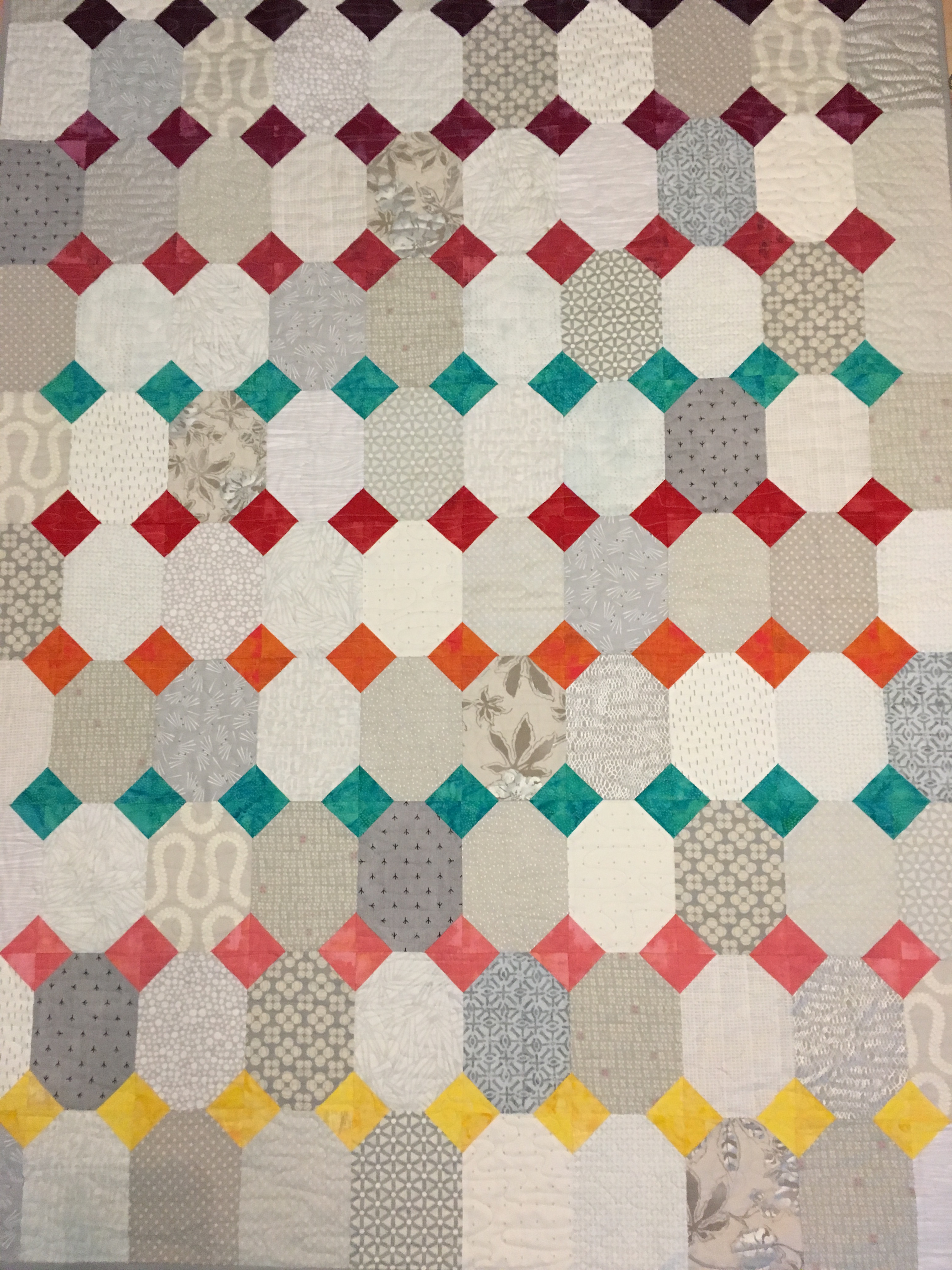
Despite my love of loads of color, I wanted to try making a quilt that was mostly neutrals. So I shopped for interesting prints in greys, ivories, light taupes and then decided to interject small spots of color in a controlled manner.

However, I wasn’t super excited about the result, so I hung it in the closet and moved on to the next quilt.  But when I bought my HandiQuilter Simply 16 quilting machine a couple weeks ago, I needed a small quilt to practice on. So I pulled it out of the closet and went shopping for backing fabric. When I saw the colorful insects on a cream background in the 50% Off section at a local shop, and having recently heard about and read reports of the dwindling insect populations around the world, I pulled the fabric off the shelf figuring it would be perfect for the back of my mostly neutrals quilt. And what better name for the quilt than, “In Praise of Insects!”

I worked for a day basting the quilt first, then loaded it onto the HQ Simply 16 machine and went to town, using one of my favorite quilting patterns: water.  It’s a nice all-over design that pulls everything together, including, to my pleasure, the various greys, taupes, ivories and creams, which I sometimes wondered if I had made the right decision in putting them together the way I did.

But I’m happy to say that I’m pleased with the result. And last night, after finishing up the hand-sewn binding, I slept under the quilt just to try it out. Ahhh!

Cost: $155 (includes US domestic shipping)

In Praise of Bugs quilt

$155.00


Fall Flight

I obviously love this quilt pattern because this is the fourth version I’ve made of it! The pattern comes from Bonnie Hunter’s website, http://www.quiltville.com.  She is the absolute queen of making scrappy quilts and I love to scroll through her website just to see what she does.

I named this quilt Fall Flight, not only because of the colors — bright blue skies as a backdrop for trees changing into their autumn colors and then dropping their leaves — but because of the border fabric showing birds in flight.

The quilting design (a Sashiko pattern called, “Fishnet”) is in blue thread, and was done by a professional long-armer, but now that I am getting my own long-arm machine (Yippee!) it might be the last quilt I’ll pay someone else to quilt for me.

I can’t wait to sleep under this one tonight.

Broken Dishes

IMG_1100

My mother helped me make my first quilt in 1979 while we waited for the birth of my first baby in India. She’d brought with her from America, (along with diapers, a washboard for washing diapers by hand (!), a couple stuffed animals, baby bottles, and so on) some patterns and ideas for the quilt and I chose the pattern called  Broken Dishes. A good name for all those triangle pairs, isn’t it?

We found some sweet ginghams and calicos in primary colors in the bazaar and set to tracing triangles out on the fabric with a cardboard template and then cutting each one out with scissors one by one by one.  (The quilting world had not seen the invention of rotary cutters and rulers yet, which has increased the speed of patchwork by lightyears.) On my mother-in-law’s old sewing machine we pieced the triangles together, then added a couple layers of flannel for the batting (stuffing) and finished it off by tying it together with yarn. I was very proud of my first effort, but more importantly I fell in absolute love with patchwork.

Unfortunately for my baby’s sake, it was way too hot for the quilt to be used! The hottest temperatures I’ve ever experienced were his first summer in Gujarat when it reached 114 degrees in June, before the rains finally arrived.  The only clothes I felt justified in dressing him in were gauze or light-weight cotton shirts and his cotton diapers. The quilt merely draped his little bamboo crib, adding some color and stimulus to the room.

That was one of the hardest summers of my life and sometimes I’m sorry for putting my baby through the misery of that heat. Thankfully he doesn’t remember the thirst. The heat rash. The prickly sweat. The sheer hellishness of the temperatures in that small cement apartment above the TB ward on the hospital compound. And that is a mercy!

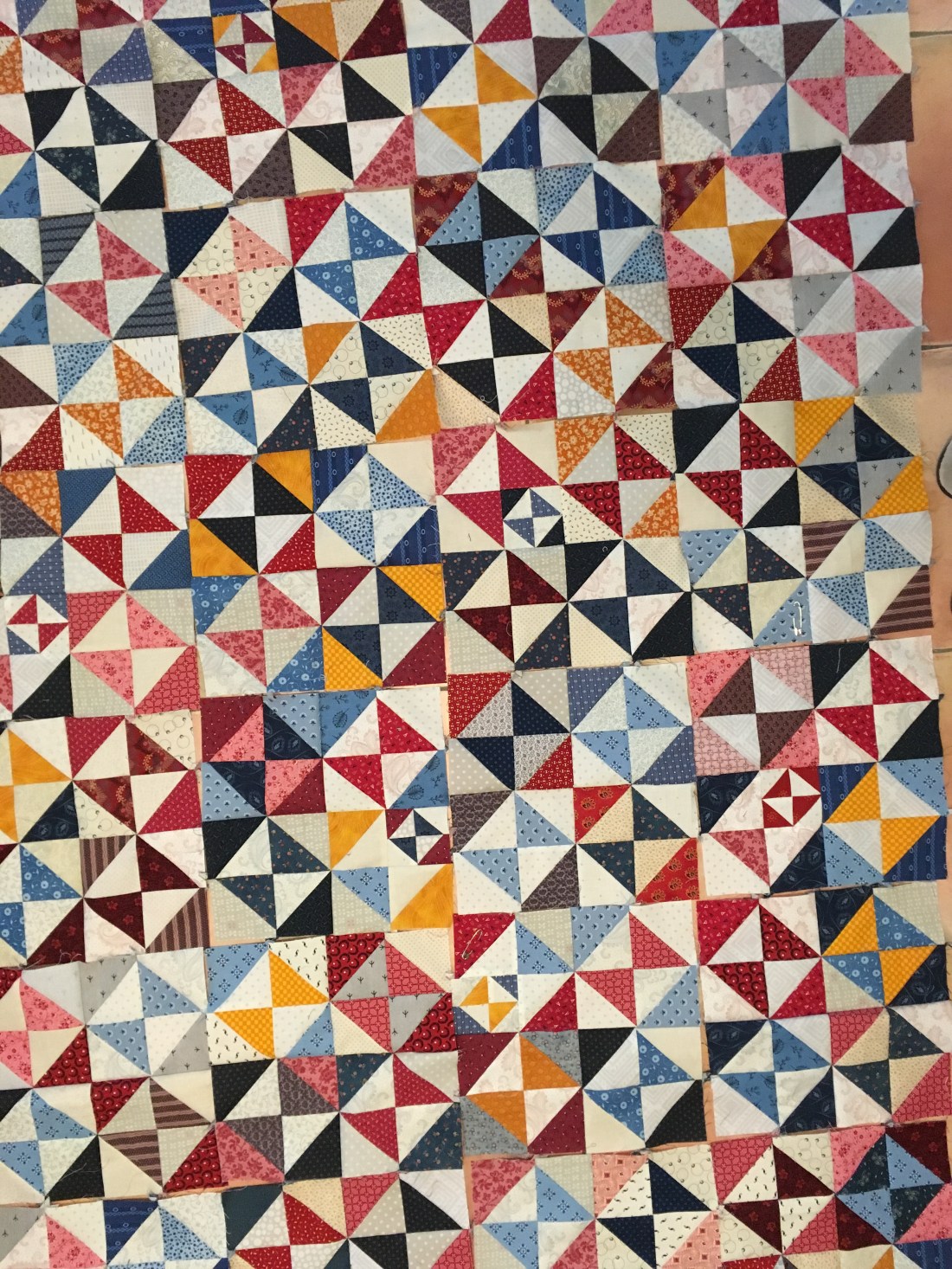
Now my “baby” is soon turning 40. Maybe because of that, or for some other mysterious reason, I got a hankering for another Broken Dishes quilt. So I got out what I have left of the 1800’s Reproduction fabrics (also known as “granny prints”) that I collected while working at a local quilt shop and started cutting and sewing, cutting and sewing. I didn’t have enough pinks and light blues, so, of course, that meant an excuse for another trip to the quilt shop!  I haven’t used this style of fabrics for years, batiks being my usual palette and aesthetic. “Repros”, as we quilters call them, do have their own quaint charm.  The tiny triangles were a later idea and I like the way they play into the theme of scattered shards.

The result (photo above and below) is a quilt with about 600 triangles and measures about 62″ square. I think I’ll choose an all-over “circles” design for the quilting, to be done by a long-armer. I’ll post a photo of the finished quilt. Soon, I hope! I’m still putting the blocks together. With all those angles and points, the journey is a slow and careful one. 

IMG_1107

Colors of India

fullsizeoutput_f30

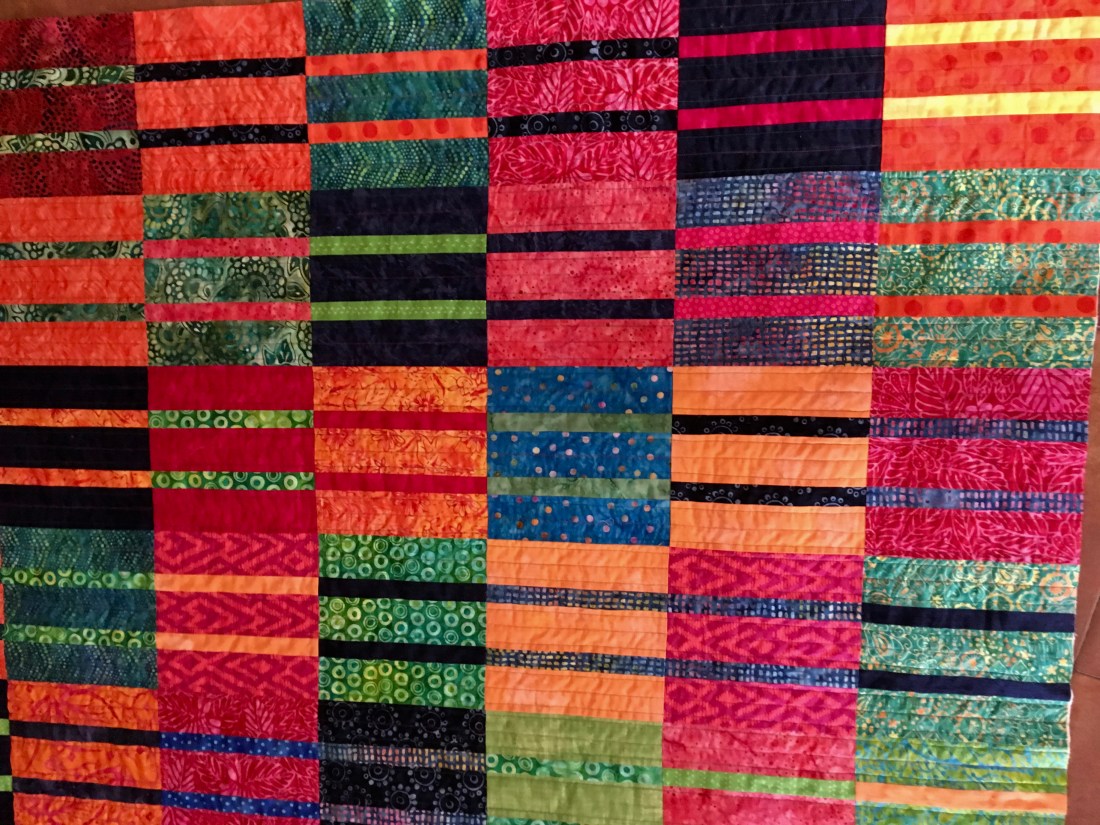
This is an example of a quilt inspired by the colors of the land I grew up in, where often one can see shocking color combinations. What cools down the spiciness of this quilt are the blues and cooler greens. Simple straight lines of quilting imitate the narrow bands of vertical color, and voila, the quilt is done! This pattern is one of Amy Walsh’s, whose wonderful designs are not difficult to put together. Check out her gallery of fresh colorful modern designs here:
https://www.blueundergroundstudios.com